



As Americans head to the polls for the final day of midterm voting on Tuesday, candidates are making their final appeals to voters in high-stakes House and Senate races that will determine the balance of power in Congress, where Republicans currently control both chambers.
A shift in the balance of power could curb the executive influence of President Donald Trump and could have meaningful implications on domestic and foreign policy amid a generally unpopular U.S. war with Iran, climbing inflation and record high fuel prices that have strained American households.
Here's a look at some key Senate, House and gubernatorial races to watch that could help define the outcome of the 2026 midterms:
Key Senate races
Thirty-five Senate seats are in play during the 2026 midterms, but the outcome of a few competitive races in both battleground and traditionally Republican states, will determine which party will control the upper chamber of Congress next year.
Some of the most competitive and consequential Senate contests are brewing in states like Michigan, Texas, Alaska, Ohio and Kansas.
Republicans currently hold 53 seats, while Democrats have 45 seats, in addition to independent senators Bernie Sanders and Angus King, who also caucus with the Democratic Party, giving them a total of 47.
Democrats need to win four additional seats to shift the balance of power, while Republicans can afford to lose up to three seats and keep the majority, with the tie-breaking vote of Vice President JD Vance.
Leading into the midterms, Trump has not only campaigned for Republican candidates in battleground states like Michigan, Georgia and North Carolina, but has also embarked on a red-state push in more reliably Republican states like Texas, Ohio, South Carolina, Florida, Iowa, Kansas and Mississippi.
Asked about his effort to bolster Mississippi Republican Sen. Cindy Hyde-Smith, who is defending her seat against Democratic District Attorney Scott Colom, Trump said, he "can't take a chance."
Michigan: This race has been a bitter fight between former GOP rep. Mike Rogers and former public health official Abdul El-Sayed, a progressive in a race that has highlighted the divide over U.S. support for Israel and has put El-Sayed on the defensive amid attacks from pro-Israel groups. And days before Election Day, a surprise endorsement for Rogers from El-Sayed's Democratic primary opponent, Haley Stevens, roiled an already contentious race, with Democrats criticizing Stevens and Republicans welcoming her support.
Texas: The last time a Democrat won a U.S. Senate election was in 1988. State Attorney General Ken Paxton is running a close race against Democrat James Talarico, a former state representative and Presbyterian seminarian. Paxton has waded into the culture wars in his attacks against Talarico, while the Democrat has kept his message on the economy front and center and criticized the attorney general over a series of political scandals that have embroiled Paxton's career.
Alaska: Incumbent Republican Dan Sullivan is running against former Democratic Rep. Mary Peltola, another candidate with the same name who is on the ticket as an independent in a surprisingly close race in this ranked-choice voting state.
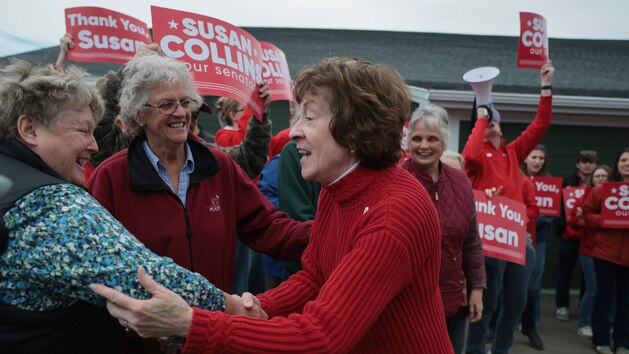
Maine: Longtime Maine Republican Sen. Susan Collins, a moderate, is defending her seat in a competitive race against Democrat Troy Jackson, a former Maine Senate president and majority leader.
Ohio: Incumbent Republican John Husted and former Sen. Sherrod Brown, who lost his 2024 re-election bid, are fighting for a chance to return to the Senate in a race that ABC News rates Tossup.
Kansas: This race was not expected to be competitive after Trump won the state by a large margin in 2024. Incumbent Republican Sen. Roger Marshall is facing off against Democrat Adam Hamilton, senior pastor of the largest United Methodist congregation in the nation.
Also worth watching: Polls also show close races in more reliably Republican states like South Carolina, Nebraska and Mississippi, where no Democrat has been elected to the U.S. Senate since 1982.
Key House races
All 435 seats of the House of Representatives are on the ballot on Tuesday for two-year terms in the 120th Congress, but 14 of those seats that ABC News rates as Tossup are going to be crucial to determining the balance of power in the House next year.
Key races to watch are in Colorado, Iowa, Michigan, Montana, New York, Ohio, Pennsylvania and Virginia, while a handful of other consequential races are in congressional districts that were redrawn by Republican legislatures in Alabama, Florida, Kentucky and Virginia.
To shift the balance of power, Democrats need to gain at least three seats.
The Republican caucus, led by Speaker Mike Johnson of Louisiana, currently holds a slim majority over Democrats with 220 seats, while Democrats have 215.
Democrats, who last controlled both chambers during the 117th Congress in Trump's first term (2021--2023), are aiming to make history by electing at least 100 Democratic women to the House, which would set a new record.
Out of 435 seats in the House, 125 are currently held by women, including 95 Democrats and 30 Republicans.
In the 14 Tossup races, seven Democratic women are running against Republican opponents.
Key gubernatorial races
Several female gubernatorial nominees could break barriers this election cycle.
Twenty-six women are major-party nominees overall, one more than the 2022 record of 25, including 19 Democrats and seven Republicans.
In Texas, Gina Hinojosa could become the first Latina governor. In New Mexico, former Interior Secretary Deb Haaland would be the first Native American woman to serve as a governor. And in Georgia, Keisha Lance Bottoms could become the state's first woman governor and the first Black woman to govern any state.
And in Ohio, Democratic nominee Amy Acton, who would be Ohio's first female governor, is facing off against Republican nominee Vivek Ramaswamy.
Ramaswamy faced bipartisan backlash for a controversial attack ad against Acton that featured her estranged mother calling her liar.
Acton, who has spoken out about being a victim of sexual abuse, said that her mother stood by the man who criminally charged with sexually abusing her as a child before his death in 2004.
In a final push before Election Day, Trump and former President Barack Obama -- the last Democratic president to serve two terms -- have made direct appeals to voters, appearing at rallies to bolster congressional and gubernatorial candidates in competitive races.
Obama, who appeared at a rally for Acton on Oct. 24., urged voters to channel their frustration by exercising their right to vote.
"They can't hear your boos. They hear your vote," he said.
Ahead of midterm voting, Trump announced at the GOP's midterm convention on Sept. 9 that he would give adult Americans a $5,000 cash payment that he called the "Trump Dividend" if Republicans keep control of the House and Senate.
While some critics cast this proposal as a bribe, the president has defended it and repeated the pledge at campaign rallies. When pressed on the proposal by ABC News, he denied that the promise of this payment was meant to encourage voter turnout and claimed that the government would pay for it through economic "growth."
Appearing at a rally last week in Corpus Christi, Texas, the president urged his supporters to vote Republican up and down the ballot.
"We're going to elect Republicans up and down the line," he said. "We need that vote, otherwise, all of the great things we've done are going to change very quickly."
ABC News' John Parkinson, Allison Pecorin, Lauren Peller, Juhi Doshi and Max Zahn contributed to this report.
Copyright © 2026, ABC Audio. All rights reserved.